
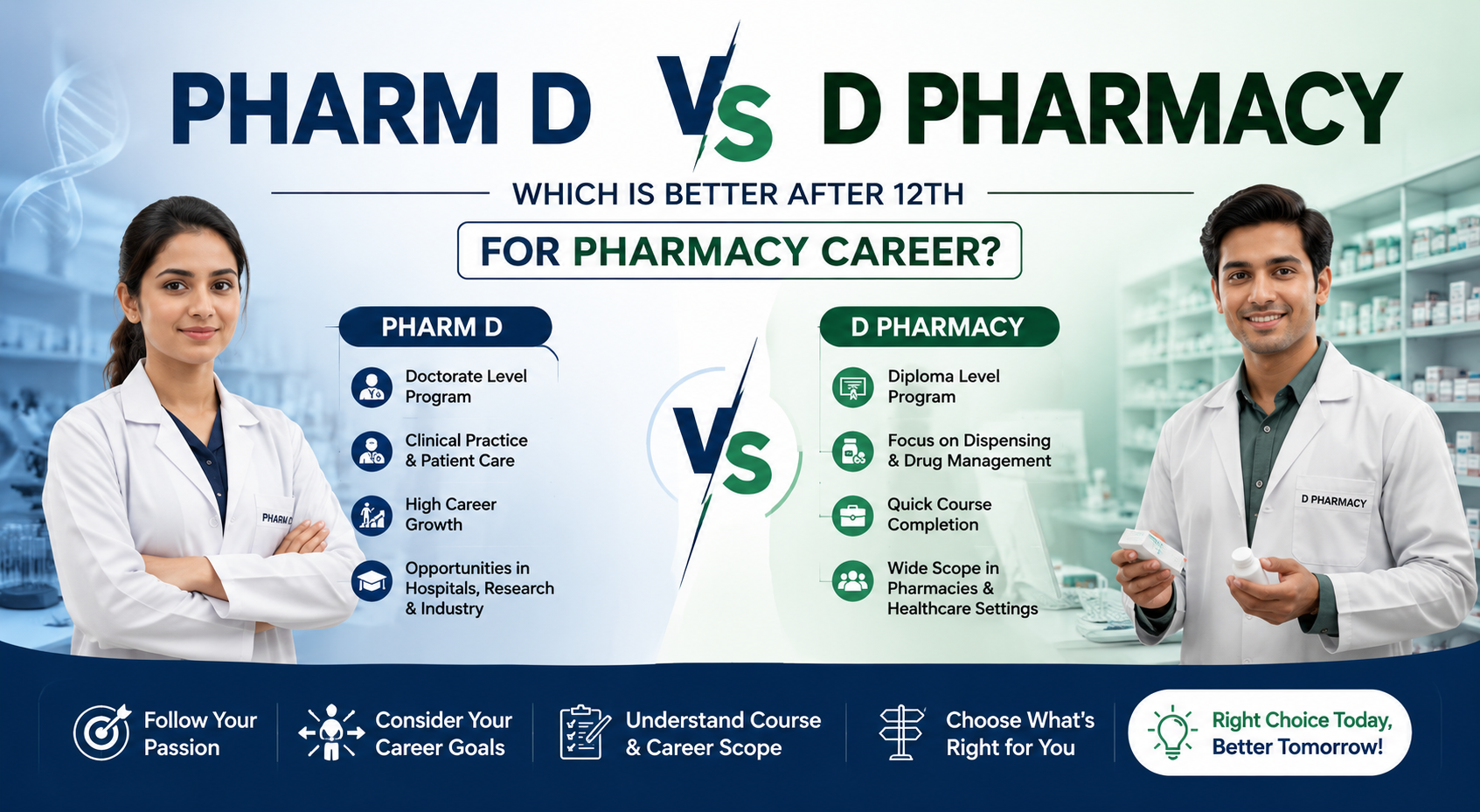
First Understand One Basic Thing These Two Courses Train You for Different Worlds
This is where many students make the mistake. They think B.Pharm and Pharm.D are almost similar because both are pharmacy courses. Academically that may sound true, but professionally it is not.
B.Pharm is more of a conventional pharmacy graduation. It teaches the science of medicines, how drugs are made, what chemicals are used, dosage forms, quality checking, manufacturing systems, pharmaceutical calculations, and related industry subjects. It gives a broad foundation, no doubt, but the training remains more classroom and lab centered.
Pharm.D, on the other hand, takes the student much deeper into the healthcare side of medicines. Here, the focus is not only “what is the drug” but also:
- why this medicine is given,
- whether the dose is appropriate,
- what interaction may happen,
- how the patient is responding,
- what adverse event can occur,
- whether therapy can be improved.
That is a huge practical shift.
This is the reason many senior professionals now say:
B.Pharm teaches medicine as a product.
Pharm.D teaches medicine as a treatment responsibility.
And that difference matters heavily in current job market.
The Pharmacy Market in 2026 Is No Longer the Same as Before
Ten years ago, a large number of pharmacy graduates were absorbed mainly in pharmaceutical factories or MR jobs. Even today those jobs exist, but the competition has become intense and the growth is not always satisfying for every graduate.
At the same time, new sectors have opened rapidly:
- pharmacovigilance companies,
- hospital clinical pharmacy departments,
- clinical research organizations,
- healthcare documentation firms,
- medical writing agencies,
- patient safety centers,
- insurance medication audit teams.
These sectors are not just asking for a pharmacy degree — they are asking for clinical understanding.
A person who has only industrial exposure may need extra training to fit there.
A Pharm.D graduate already studies these things during the course itself.
That is why when students ask “which pharmacy course has actual future demand,” the answer is now leaning much more toward Pharm.D than it did a few years ago.
Hospital Exposure Changes the Confidence Level Completely
One practical point students usually ignore while taking admission is exposure.
Degree is one thing. Working confidence is another.
Most B.Pharm students spend their years with practical labs, records, viva, formulation experiments, chemistry handling, industrial notes, and subject theory. Useful, yes — but direct patient handling is almost absent.
Pharm.D students live a very different academic life.
They spend time in:
- hospital wards,
- case discussions,
- prescription auditing,
- patient interviews,
- medication history review,
- ADR reporting,
- therapeutic presentations.
By the final internship period, many of them are already comfortable discussing medicines with clinicians and understanding disease files.
This creates a very different professional personality.
When such a student sits in an interview for hospital pharmacist, drug safety associate, clinical research coordinator, or medication analyst role, they are not speaking only from books they are speaking from hospital case exposure.
That makes a visible difference.
B. Pharm Career is not bad, But It Is More Limited Unless You Upgrade Further
This needs honest discussion because many websites only praise one side.
B.Pharm is not a useless degree. It still has value and thousands of students build careers from it.
After B.Pharm, common areas remain:
- production,
- quality assurance,
- quality control,
- pharmaceutical packaging,
- medical representative,
- sales promotion,
- wholesale/retail pharmacy,
- some documentation roles.
But one issue many graduates later realize is this:
to move upward, specialization becomes necessary.
That is why many B.Pharm students eventually go for:
- M.Pharm,
- MBA,
- regulatory affairs certifications,
- pharmacovigilance training.
In simple words, B.Pharm often becomes the first step.
It is rarely the final strong differentiator now.
Pharm.D Opens More Directly Specialized Doors
This is where students notice the practical advantage.
Because Pharm.D is clinically aligned, the student does not enter the market as just another general pharmacy graduate.
They can directly target modern sectors like:
- Clinical Pharmacist roles
- Pharmacovigilance Associate
- Drug Safety Case Processor
- Medical Writer
- Clinical Data Reviewer
- Patient Counseling Executive
- Hospital Medication Auditor
- Research Coordinator
- Medical Coding and Healthcare Documentation
These are not random side jobs — these are exactly the sectors that have shown consistent pharmacy hiring in recent years.
And most importantly, these sectors usually value analytical understanding more than pure manufacturing knowledge.
So professionally, Pharm.D students enter a narrower but stronger niche — and niche qualifications often survive competition better.
Let Us Talk Honestly About Salary Because Students Ultimately Want Stability
Students may hesitate to ask, but salary is always in mind.
With B.Pharm, initial packages in many traditional sectors are often average, especially in factory-quality roles or beginner marketing jobs. Growth happens, but it can be slow unless the person changes profile or adds qualifications.
Pharm.D does not magically guarantee huge money from day one, but the type of jobs available are generally more specialized. Specialized jobs tend to pay better over time because fewer graduates fit them properly.
Hospital clinical roles, pharmacovigilance companies, multinational safety processing firms, healthcare consulting support, medical writing, and clinical trial documentation usually offer a more professional progression path.
This is why many Pharm.D graduates report a better long-term salary trajectory than standard B.Pharm graduates of the same batch.
Abroad Scope Is Another Major Reason Students Are Rethinking Their Choice
Today’s students are not thinking only locally.
A large number plan for healthcare opportunities abroad in countries like Canada, United Kingdom, Australia or United Arab Emirates.
For these healthcare systems, clinically trained pharmacy profiles always stand stronger than basic industry-only understanding.
Pharm.D gives a student a more relevant narrative for:
- medication review,
- patient safety,
- therapeutic assistance,
- hospital support,
- pharmacovigilance.
This does not mean B.Pharm has no route, but B.Pharm candidates usually have to add more credentials before reaching the same professional positioning.
So Why Are More Counselors Now Suggesting Pharm.D?
Because the pharmacy profession is silently shifting from:
“drug manufacturing manpower”
to
“drug therapy expertise.”
That shift is not temporary.
Medicine errors, polypharmacy, chronic illness management, adverse event surveillance, and evidence-based treatment monitoring are all growing healthcare priorities.
Hospitals need medicine experts.
Drug safety companies need case experts.
Research organizations need documentation experts.
And Pharm.D was academically designed around these exact demands.
That is why this course is no longer just a fancy title degree. It is slowly becoming one of the strongest clinical healthcare qualifications inside pharmacy education.
Final Practical Opinion: Which One Should a Student Choose?
If someone wants a shorter conventional pharmacy graduation and plans to move later according to circumstances, B.Pharm can still work.
But if the student already knows that they want:
- stronger hospital identity,
- more professional specialization,
- better healthcare relevance,
- broader modern job profiles,
- improved international acceptance,
- and a future-proof pharmacy career,
then choosing Pharm.D in 2026 looks like a much smarter strategic decision.
Because in current reality:
B.Pharm may give you entry into the pharmacy profession.
But Pharm.D gives you a more defined professional position inside the future healthcare system.
And that distinction is exactly why the discussion between these two courses matters so much now.
Conclusion
B. Pharm and Pharm. D are both prestigious pharmacy degrees but meant for different career tracks. B.Pharm still remains a good option for students interested in pharmaceutical manufacturing, quality control, sales, and industry-based roles. But in 2026, the healthcare industry is increasingly looking for professionals with solid clinical knowledge and patient-care skills. Pharm.D gives more exposure to Hospitals, specialization, and new areas like Clinical pharmacy, Pharmacovigilance, Medical writing and Drug safety. The Pharm.D. is increasingly the preferred degree for those students who want a future-oriented career in pharmacy that is more relevant to health care.

Frequently Asked Questions (FAQs)
1. Which is better between B.Pharma and Pharm.D after 12th?
B. Pharma can be considered for those who desire to follow a traditional pathway in pharmacy in areas like manufacturing, quality assurance, or pharmaceutical sales. Whereas those aspiring for a clinical practice in patient care, hospital pharmacy, or other such areas can go for Pharm.D.
2. Is Pharm.D equivalent to MBBS?
No. Both are separate professional courses. MBBS degree holders become physicians and treat diseases. On the contrary, Pharm.D professionals concentrate on medicine and its management, clinical pharmacy etc.
3. Are job prospects in Pharm.D better than B.Pharma?
Yes, Pharm.D professionals have a definite advantage in sectors including pharmacovigilance, clinical research, medical writing etc. due to their training in the clinical field.
4. Can a B. Pharma graduate get a job in a hospital?
Yes, one can join as a pharmacist in a hospital as B.Pharma graduates do have that opportunity. However, some specialized posts might require individuals with a Pharm.D. qualification.
5. Is B.Pharm or Pharm. D more internationally relevant?
The Pharm.D program is typically more internationally relevant since it includes both clinical and patient care education. The global health system recognizes the importance of pharmacists who can help develop medication therapy management programs for patients.